
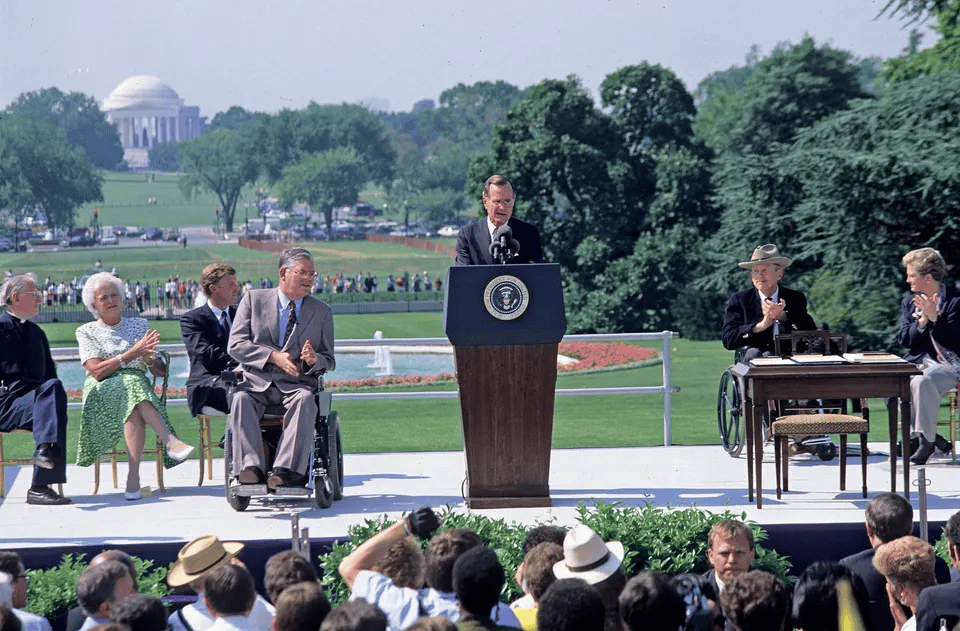
This July marks 36 years since the Americans with Disabilities Act was signed into law. The legislation that came out of decades of organizing by Disabled activists, including the 1990 Capitol Crawl, reshaped what it means to enter a building, hold a job, get an education, or move through public life in this country. It remains one of the most consequential civil rights laws in American history.
The leaders below are among countless others carrying that work forward right now, across media, fashion, policy, talent representation, literacy and the creator economy. They are ensuring the movement continues, expands, and evolves, and that the legacy of those who came before us is honored.
It is worth noting that this year’s anniversary arrives at a moment when the legal architecture protecting Disabled people is under sustained pressure. In Texas v. Kennedy, formerly Texas v. Becerra, six states are asking a federal court to strike down the federal rule that enforces the Olmstead integration mandate, the 1999 Supreme Court decision recognizing the right of Disabled people to live in their communities rather than in institutions.
The suit was filed in January 2026 by nine states, with Indiana, Kansas, and South Dakota withdrawing in the months since following pressure from the disability community. An earlier version of the litigation sought to declare Section 504 of the Rehabilitation Act unconstitutional outright, before that claim was withdrawn under similar pressure. Section 504 is the law that first established protections against disability discrimination by any entity receiving federal funding, and that served as a blueprint for the ADA itself.
On June 18, 2026, days before the 27th anniversary of the Olmstead decision, the Department of Justice's Office of Legal Counsel released a memo arguing that neither the ADA nor Section 504 requires states to serve Disabled people in the most integrated setting appropriate. The memo acknowledges its reading is at odds with how federal courts have understood Olmstead for nearly three decades. The opinion carries no force of law. It signals that federal enforcement of the integration mandate is expected to pull back significantly.
At the same time, the federal Department of Education is being dismantled in pieces. On June 16, 2026, the administration announced interagency agreements moving the Office of Special Education and Rehabilitative Services, which administers the roughly $15 billion Individuals with Disabilities Education Act, to the Department of Health and Human Services, and moving the Office for Civil Rights to the Department of Justice. IDEA serves more than 7.5 million Disabled children. Disability organisations including The Arc and the Council for Exceptional Children have warned the change risks shifting special education from an education framework to a medical one, undoing decades of progress toward integration in schools.
Meet Disabled Changemakers Reshaping Their Industries This Disability Pride Month
Mychal Threets, Librarian, Author, and Host of Reading Rainbow
Mychal Threets, known to more than 850,000 TikTok followers as Mychal the Librarian, is a literacy and mental health advocate, social media creator, and the new host of the rebooted Reading Rainbow on PBS. He is also the author of the children's book I'm So Happy You're Here: A Celebration of Library Joy, published by Penguin in February 2026.
His connection to libraries is foundational. His mother homeschooled him and his siblings at their local library in Fairfield, California, an experience he has spoken about openly. "Our entire curriculum was built at the local library," he told Antonio Michael Downing in an interview on CBC's The Next Chapter. "So when you talk about a sanctuary, when you talk about the library being the safe place, it's all I've ever known."
Threets is equally candid about his mental health, including the anxiety and depression he has lived with since childhood, and the decision in 2024 to step back from his library role to prioritise his recovery. That openness sits at the centre of how he defines library joy: a place where everyone belongs, including the people most often told they don't.
Whit Downing, Vice President of Policy and Programming, Kansas Council on Developmental Disabilities
Whit Downing leads statewide initiatives on disability policy, behavioural health partnerships, systems change, and self-advocacy at the Kansas Council on Developmental Disabilities. An autistic self-advocate with lived experience in both intellectual and developmental disability and mental health systems, she spent eight years on the Kansas IDD waiver waitlist before joining KCDD as a contract worker in early 2024. She was promoted into her current leadership role within ten months.
She testifies regularly before the Kansas Legislature, leads KCDD's Behavioural Health Workgroup under the Statewide Health Equity and Outcomes Coalition, and acts as a liaison to state behavioural health partners. She is also the founder of "We All Matter," a mental health support group for teens and adults with intellectual and developmental disabilities that connects participants with peer support and a licensed mental health professional. The throughline of her work is that meaningful systems change happens when people with lived experience are trusted as leaders shaping policy, services, and community solutions.
Patrick McMullen, Founder, Inclusify Studio
Patrick McMullen is Deaf and the founder of Inclusify Studio, the first Deaf-owned influencer marketing agency. He built a 1.3 million-follower TikTok presence before turning that platform into a business connecting brands with Deaf and hard-of-hearing creators.
His focus this year is getting Deaf and hard-of-hearing stories seen, valued, and paid for. "When brands work with Deaf and hard-of-hearing creators, they help people in our community see themselves represented on screen. They help people outside our community understand who we are. And they show that Deaf and hard-of-hearing creators are storytellers, leaders, and culture-makers."
McMullen say’s, "There are 430 million people in the world living with hearing loss across countless communities, cultures, and languages. If you are a brand, an agency, or someone with a platform, seek them out. Hire them, amplify them and give them real opportunities."
Paula Sojo, Patient Advocate and Co-Founder of Osto•me Fashion
Paula Sojo was diagnosed with severe Crohn's disease at 18. After life-altering ostomy surgery, she started making ostomy covers that complemented her own wardrobe. That side project became Osto•me Fashion, which she co-founded with her brother Daniel Sojo in 2022. Today the brand serves ostomates in more than 40 countries and has been covered by Vogue, People, and BNN Bloomberg.
Sojo is focused on widening the public picture of who Disabled people are. "Too often, when someone sees a person with a disability, their perception begins and ends with the limitations they assume that person must face," she says. "What is frequently overlooked are all the things that make us who we are: our passions, careers, relationships, talents, ambitions, and dreams. We are people first, each with unique stories, talents, and aspirations.”
Her call to action is one question. “What if that were me? When we lead with empathy, we move beyond assumptions and stereotypes. We begin to recognize the humanity, resilience, and individuality in every person.”
Syanne Bloom, Disability Justice Activist and Political Commentator
Syanne Bloom is a disability justice activist and political commentator whose work examines how public policy, healthcare systems, and institutional decision-making shape the lives of Disabled people. A Disabled Afro-Indigenous Latina and wheelchair user, she holds a degree in history and brings more than a decade of experience in political advocacy, nonprofit leadership, and digital media. Her platform reaches nearly 100,000 people across her social networks, where she translates complex policy debates into accessible public conversation.
She says that disability cannot be siloed. "Right now, I'm focused on helping people understand that disability intersects with healthcare, reproductive justice, immigration, and nearly every policy decision that shapes our lives," she says. "Too often, these issues are discussed separately, even though the people most affected are living at those intersections. Through storytelling and political education, I work to connect those dots, showing how decisions about healthcare access, ICE detention, reproductive freedom, and social safety nets all impact disabled people. My goal is to help people see disability as an essential lens for understanding human rights and building policies that allow everyone to live with dignity."
Bloom has a concrete call to readers. "Immigration is a disability issue. Disabled people are disproportionately represented in detention, where inaccessible conditions, inadequate medical care, and systemic neglect put lives at risk. No one should be denied healthcare, dignity, or basic human rights because of their immigration status or disability. Real change happens when people refuse to look away, and every signature helps build public pressure for a more just and humane system." Readers can sign her Change.org petition calling for the closure of ICE detention centres.
Sarah Todd Hammer, Disabled Influencer, Speaker, and Consultant
Sarah Todd Hammer was eight years old when she became paralysed from the neck down. She has since regained the ability to walk and built a following of more than 450,000 across her platforms. She is a three-time published author, modelled for Kohl's Adaptive at New York Fashion Week, holds a Certified Professional in Accessibility Core Competencies credential, and has partnered with brands including Rare Beauty, JCPenney and Tilt Beauty.
Her content showing accessible meal options at the grocery store, or how she completes everyday tasks, is a deliberate strategy. "I want people to not only see disability as affecting a person's body, but also affecting the ways in which we interact with others and our environment, even down to the choices we make when shopping at the grocery store," she says. "I hope that, through sharing these many facets of my life, people realize that disabled people lead beautiful, yet complex, lives that deserve to be shared."
On Disability Pride, she says "As a disabled young woman, I exist and live as my true, authentic self unapologetically every day, not just the month of July."
Elle Potruch, Founder, EP Talent
Elle Potruch founded EP Talent in 2024 as a boutique talent management company representing Disabled creators, speakers, actors, and public figures across lifestyle, storytelling, and advocacy. The talent she represents reaches more than 7 million people collectively and has partnered with brands including Sephora, JCPenney, AbbVie, and Amazon, with appearances in productions for Netflix, HBO, BBC, and Lionsgate.
Potruch drew from her own lived experience as a Disabled woman. "For a long time, our community has been conditioned to feel grateful simply to be included, which can make it difficult to advocate for fair compensation, set boundaries, or walk away from opportunities that aren't aligned," she says. "A big part of my work is helping creators understand the value of their time, creativity, expertise, and lived experience so they can make confident, business-minded decisions."
Potruch says, "My hope is that more brands, agencies, networks, studios, and decision-makers stop viewing disability inclusion as a niche initiative or a box to check, and start recognizing it for what it is: smart business. As you plan your next campaign, write your next casting breakdown, or build your next strategy, ask yourself one simple question: whose perspective is missing from the table?"
Nila Morton, LMSW, “Your Favorite Disabled Hottie”
Nila Morton is a licensed social worker and a youth coordinator for a nonprofit in DC. She lives with Ullrich muscular dystrophy and uses a wheelchair. Her advocacy sits at the intersection of race and ableism, with a particular focus on the experiences of Black and Brown Disabled communities. She has interned at the US Department of Transportation under a disability policy advisor.
Morton takes on conversations the wider disability conversation often skips. "A big part of my work centers on disability and desirability, whether I'm sharing my own experiences or unpacking the harmful misconceptions around disability and sex," she says. "It's not just about proving that (consenting) disabled people can have sex; it's about challenging the deeper narrative that denies us full humanity and autonomy."
She also pushes the fashion industry to do better. "Adaptive fashion is still often treated as an afterthought. Disabled people want style, color, texture, and trend-driven pieces just like anyone else. Accessibility does not have to come at the cost of creativity."
Her call to readers is something most can act on immediately. "Recognize that disability is the one community anyone can become part of at any time. Listen to disabled voices. Educate yourself on disability history and the work of advocates. Follow and support disabled creators. Most importantly, be intentional about including disabled people in your everyday life."
Maddy Ullman, Disability Advocate, Storyteller, and Consultant
Maddy Ullman consulted on disability representation for Disney's Wish, where she helped shape Dahlia, the studio's first visibly Disabled Asian American animated character. Ullman is a Disabled transracial adoptee and wheelchair user, she speaks at conferences nationally and works with organisations, artists, storytellers, and employers on authentic representation and inclusive experience design.
Her view of Disability Pride is grounded. "It's not about being overbearing or being proud of the fact I am disabled. I am very proud to be the person that I am, but disability pride is just existing in this world and choosing to live in it," she says. “Because it is stressful and disability rights are under attack and right now existence is revolutionary. Believing what I can do is enough.”
Her call to readers asks them to do something with what they learn. "It may be Disability Pride Month, but our work doesn't end with awareness, it begins with action. Learn from disabled voices. Engage with the disability community, not just during July, but all year. Be an active ally, not a passive observer. The most meaningful progress happens when disabled people are not just invited into the conversation, we are helping lead it."
Dom Kelly, Co-Founder, President and CEO of New Disabled South
Dom Kelly is the Co-Founder, President and CEO of New Disabled South, the first regional disability justice organization in the US South, and its 501(c)(4) advocacy arm New Disabled South Rising. One of a set of triplets born with cerebral palsy, he has been organizing in the South since 2009.
Before founding New Disabled South in 2022, Kelly served as senior advisor and founding staff on Stacey Abrams' 2022 gubernatorial campaign in Georgia, and as a lead fundraiser and strategic advisor at Fair Fight Action, where he created and led the organisation's Disability Council. He toured internationally for more than 15 years with the rock band A Fragile Tomorrow, releasing six records and earning two Grammy shortlistings before retiring from music. His recognition includes the J.M. Kaplan Fund's 2023 Innovation Prize, a 2024 Rockwood National Leading From the Inside Out Fellowship, and a place in the 2025 cohort of Atlantic Fellows for Health Equity. He chairs the board of The Kelsey, which builds disability-forward inclusive housing.
This is a moment that asks something of all of us. We defend the laws that make community living possible, we protect the rights that took decades to win, and we celebrate the Disabled leaders who are carrying the movement forward, because the future of this work belongs to them.